The welcome message fails when it says everything. The short template, what belongs in a later send and the one case where the long version holds.
·12 min
The welcome message is the only message of the stay a guest receives with nothing to do about it. They have just booked. No decision to make, no door to open, no time to confirm. That is what makes the long version so expensive: everything it carries arrives when nothing has any use for it.
A welcome message has three jobs and not one more. Confirm that a human has seen the booking, say when the useful information will arrive, leave the conversation open. The rest is filler that will cost you a question.
WelcomeAt booking50 to 75 words
Hi first name, thanks for booking check-in date to check-out date. It is confirmed on my side.
I will write three days before you arrive with the exact address, how to get in and the wifi. The door code comes on the morning itself.
Until then this conversation stays open: ask anything here.
See you soon.
Two sentences carry the whole message. The first says a human has seen the booking. The second says when the practical details will arrive, which removes the follow-up from guests who plan ahead. Without it, the person who prepares a trip three weeks out writes to ask for the address.
Brackets mark the dynamic fields. Every platform and every PMS has its own syntax. Replacing them by hand inside the tool that will actually send avoids the message that reaches the guest with its brackets showing.
#What inflates the message and comes back as a question
A long welcome message does not tire the guest, which would be the lesser problem. It displaces the information: what matters slides below the fold of the phone, where reading actually happens. The first three or four lines are seen in the notification. The rest takes a deliberate scroll that nobody performs at booking time.
What often goes in
Why it comes back
Where it belongs
The house rules
Already accepted on the listing, re-read by no one
The listing, plus a targeted reminder when there is a real stake
The wifi network name
Useful once on site, forgotten in three weeks
The instructions message, at D-3
The door code
Buried by the exchanges that follow
Its own message, on the morning of arrival
The amenity list
The guest booked on that list
The listing
Neighbourhood tips
No use at all before arrival
The house manual
The Airbnb help centre lists variables you can insert in quick replies, replaced by details from the listing and the reservation: guest first name, check-in date, wifi network name, house rules. The house rules variable is the dangerous one. It costs a second to insert and it triples the length of the message with text the guest already accepted in order to book.
The cutting test is three questions, sentence by sentence. Does it give information expected now? Does it ask for an action? Does it prevent a frequent question? Three noes and the sentence goes. The six messages of the stay and their respective lengths are covered in the Airbnb message templates.
Scheduled sends follow the listing time zone, not the guest's. The Airbnb help centre states it for scheduled quick replies. On a European portfolio hosting North American guests, a message set at a comfortable local hour lands in the middle of their night. That is harmless for the welcome, which follows the booking. It is not harmless for everything after it, and the same setting governs both.
The normal sequence assumes time between the booking and the arrival. When there is none, it turns against itself. A booking made two days before arrival drops the welcome, the instructions, and the code into the same day, with a welcome promising information in three days for a guest who arrives the day after tomorrow.
Airbnb offers a sending option for last-minute bookings and short stays. Without it, some scheduled quick replies are skipped by default. So the option decides whether the message goes out, never whether it makes sense. Sense is your job.
The rule is mechanical. Below three days between booking and arrival, one single message merges the welcome and the instructions, and the scheduled sends that became redundant are disabled. That message can run to a hundred and fifty words without harm: the guest is actively looking for detail, already deep in travel logistics.
Merged welcomeBooking under 3 days out100 to 150 words
Hi first name, thanks for booking check-in date to check-out date. Since your arrival is close, here is everything straight away.
Address: address
Floor: floor, door door
Check-in from check-in time, check-out before check-out time
Access: access method. The code comes on the morning you arrive.
Wifi: network, password password
One thing on your side: roughly what time do you expect to arrive? An estimate is enough.
See you very soon.
The code stays out, even here. Everything else moves forward because the guest has a use for it today. The arrival question on the last line does two jobs: it prepares the cleaning slot and it opens the conversation before the guest is standing at the door.
A well-cut welcome removes the predictable follow-ups. It does not remove questions. It moves them to the moment they become real. Measured on a three-property portfolio, roughly one guest message in two arrives outside nine to nineteen hours, with a clear spike at twenty: that is the detail behind common guest questions, sorted by the hour the message lands.
Léa M.Airbnb4 → 7 OctoberCopilote
Welcome message, sent at booking
Thanks! We are travelling with a baby, is there a travel cot on site or should we bring one?14:06
The travel cot is provided, stored in the bedroom cupboard with a fitted sheet in its size. The high chair is not in the flat: I can have one dropped off if you need it.14:07
The welcome did its job. The question that follows fits no template: it depends on the property and on the dates.
The welcome template goes out on time with text decided in advance. It does not read the thread. The moment the guest replies, it has nothing left to offer. That is exactly the boundary covered in the limits of scheduled messages, and it is where Sentioo takes over: the welcome draft is prepared once per booking, you approve it or you reject it, then the replies that follow draw on the thread, the phase of the stay, and the property knowledge base. The calendar itself is laid out in the guide to automated messages.
The welcome message in detail: length, content and sequence
Why the welcome is the easiest message to get wrong
Every other message of the stay has a dated purpose: the instructions serve the travel day, the code serves the locked door, the departure message serves the evening before. The welcome serves nothing precise, and that emptiness attracts content. In go the rules, the amenities, the tips, the timings, since nothing else is there. The message swells until it becomes the longest thing the guest will receive, at the exact moment they have the least use for it.
What a guest actually does right after booking
They check they did not make a mistake. Wrong dates, wrong city, wrong number of guests. Then they close the app and do not come back for several days unless something worries them. A welcome message that answers that check, dates included, and announces what comes next does the whole expected job. A message demanding two minutes of reading gets the opposite of what it wants: skimmed, then forgotten wholesale, useful sentence included.
Announcing the next message is the line that saves the most follow-ups
It is the line almost no template on the market contains. Saying that the address, the access, and the wifi will arrive three days before check-in closes the question before it is asked. Without it, two guest profiles write: the one who prepares everything early, often within the week of booking, and the one who worries about having received no address. Both ask the same thing, and both already had the answer, provided someone told them when it was coming.
The door code is never sent at booking
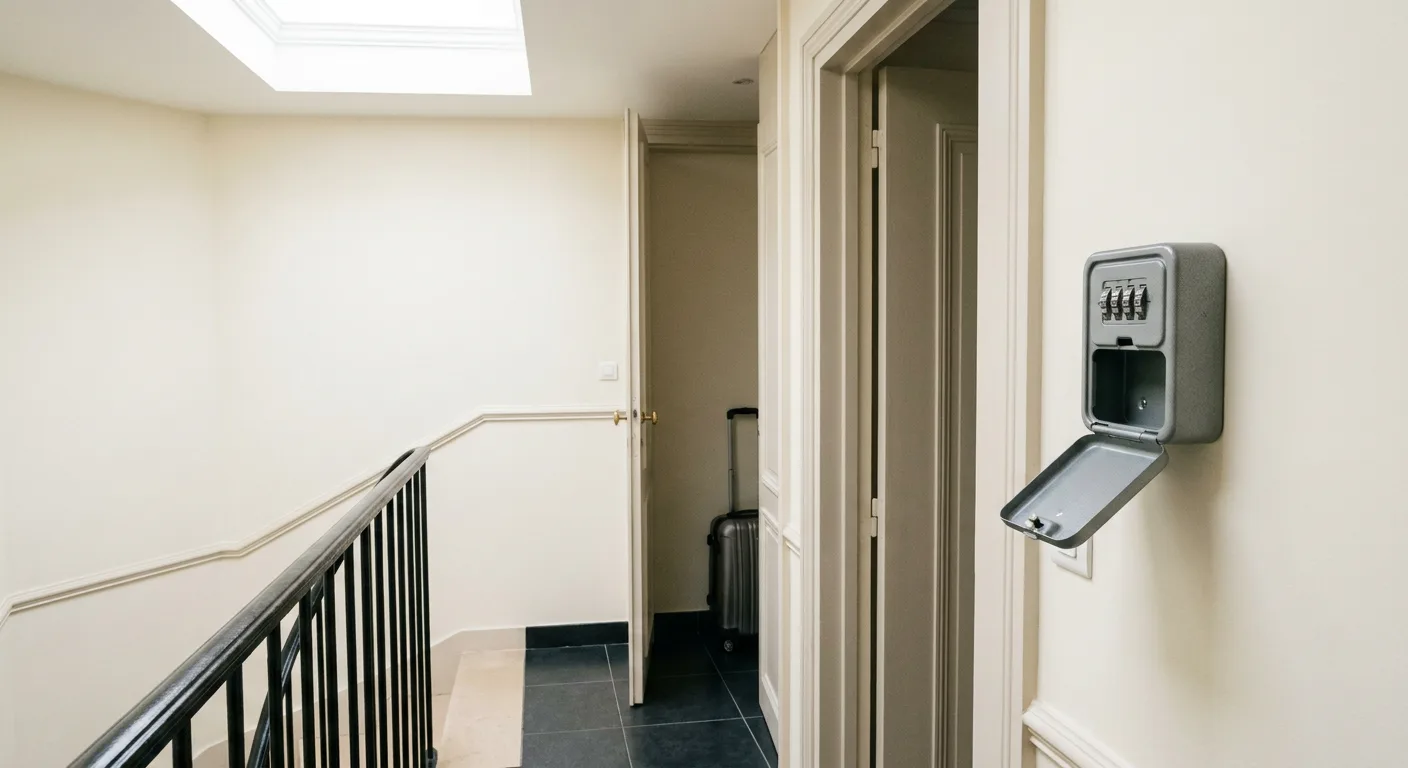
A code sent three weeks before arrival ends up buried under every exchange since. Nobody scrolls back through a conversation at a locked door, suitcase in hand, often after dark: the guest writes. The code question is one of the most frequent on the morning of arrival, and it is the one best prevented, provided the code travels alone, in its own message, on the day itself. The physical landmark matters as much as the digits: "the box to the right of the gate, under the intercom" gets found, "lockbox" does not.
The house rules variable, one click, costs the whole message
The Airbnb help centre describes variables replaced by details from the listing and the reservation. They are useful for a first name, dates, or the wifi network name. The house rules, though, are a block whose length is not up to you: it is as long as you made it on the listing. Dropped into a sixty-word welcome, it produces a three-hundred-word message, most of it text the guest already accepted in order to book.
The fold decides what gets read, not the formatting
A message is read on a phone, first in a truncated notification, then in a narrow thread. The first three or four lines are seen. The rest requires a deliberate action. No formatting changes that: not capitals, not bullets, not emoji. The only variable genuinely under your control is ORDER. What answers the question of the moment comes first, what refines it comes next, and what has no use today does not come at all.
Three days, the threshold that breaks the sequence
The gap between booking and arrival is the only condition that really changes the shape of the welcome. Above three days, the normal sequence has room to unfold and the welcome stays short. Below it, the welcome, the D-3 instructions, and the arrival-day message compress into one or two days, and two of them contradict each other about what the guest will receive next. The fix is not better writing, it is merging: one message, the one carrying what is useful today.
The last-minute option decides whether the message sends, not whether it is right
Airbnb exposes a sending option for last-minute bookings and short stays. Without it, scheduled quick replies are skipped by default, which produces complete silence on the most stressful booking of all. With it, everything sends, including messages announcing information for a date already gone. Both settings are wrong until the content has been written for that case: the option is only useful once the merged message exists.
The time zone is the listing's
Scheduled quick replies go out according to the time zone of the listing, which the help centre states explicitly. On a European portfolio hosting guests from other continents, a message set at nine in the morning local can land in the dead of night for the recipient. The welcome escapes this since it follows the booking, but it is configured in the same place as the others, and setting it up is where you meet the field. The useful check is simple: reread the send times of the whole sequence asking what time it is for the guest, not for you.
The welcome does not replace the house manual, and the reverse is true too
What is stable and consultable belongs in the manual: walking access, parking, transport, how the appliances work, recommendations. What depends on this booking belongs in the thread: dates, arrival time, code, the specific case of the stay. A welcome message that copies the manual does not replace it. It produces a version that goes stale the day the manual changes. The separation is covered in full in the house manual guide.
One question in the message, never two
When the welcome asks a question, it should be single and easy. Two questions in one message get an answer and a half: the guest replies to the last one, or to the simplest, then considers the exchange closed. On the short welcome, the best move is usually to ask none at all and keep the arrival time for the instructions message, where it genuinely serves the cleaning slot. On the merged last-minute version, it comes last, alone.
What this message can never do
A template goes out on time with text decided before the situation existed. It does not know the guest is travelling with a baby, arriving in a van, celebrating a birthday, or booking for somebody else. Those details arrive in the reply to the welcome, which is to say at the best possible moment, several days before arrival. The quality of the welcome therefore rests less on the template than on what handles the reply: the thread, the phase of the stay, and what is already known about the property.
Frequently asked questions
How long should a welcome message be?
Fifty to seventy-five words. This message lands right after the booking, when the guest has no decision to make and nothing to remember. Anything extra is read with no immediate use, so it gets forgotten, then asked again three days later as a question.
Should the door code go in the welcome message?
No. A code sent at booking ends up buried under every exchange that follows, and nobody scrolls back through a conversation while standing at a locked door. The code travels alone, in its own message, on the morning of arrival.
Does the welcome message go out on a last-minute booking?
Not always. The Airbnb help centre notes that some scheduled quick replies are skipped by default unless you turn on sending for last-minute bookings and short stays. On a booking made two days before arrival, you have to decide which message carries the welcome and which carries the instructions.
Can the house rules be inserted automatically?
The variable exists, and that is exactly the trap. The help centre lists variables replaced by details from your listing and the reservation, including the house rules and the wifi network name. Dropped into a welcome message, that block triples its length with content already on the listing and pushes the useful line off the screen.
Sentioo adapts your scheduled messages and handles the replies behind them, in your tone, from the property knowledge base. You pick the mode, property by property.